Deep Learning Tool

The easy way into deep learning with MVTec software
Labeling training data is the first crucial step towards any deep learning application. The quality of this labeled data plays a major role when it comes to the application's performance, accuracy, and robustness.
With the Deep Learning Tool, you can easily label your data thanks to the intuitive user interface – without any programming knowledge. This data can be seamlessly integrated into HALCON and MERLIC to perform deep-learning-based object detection, classification, semantic and instance segmentation, anomaly detection and Deep OCR.
The Deep Learning Tool offers- A fast path to the complete deep learning solution
- An intuitive user interface
- Active support for the optimization of the trained networks
- Easy integration into the MVTec portfolio
- Full control over your own data


Working with the Deep Learning Tool
Labeling
Data labeling is an essential task for many Deep Learning projects. During labeling, the user adds the information to the system about how the problem is solved correctly. Depending on the method, this information can be image classes, object locations or pixel masks assigned to classes or instances.
Labeling for classificationLabeling for classification is done by simply importing the images and assigning them to a class. If the images are stored in appropriately named folders, they can also be labeled automatically during import. Watch a short video here.
Labeling for object DetectionWith object detection, labeling is done by drawing rectangles around each relevant object and assigning these rectangles to the corresponding classes. Depending on the project requirements, the user can label his data with either axis-parallel or oriented rectangles. Watch a short video here.
Labeling for segmentationLabeling for semantic segmentation and instance segmentation can be done by drawing polygonal regions around relevant objects. Labeling for semantic segmentation and instance segmentation can also be done by painting pixel masks with brush and eraser that cover relevant objects. In addition, several smart labeling tools make the labeling process even faster. These tools provide users with instant labeling suggestions - either after selecting a relevant image area or when hovering over an image area.
Labeling for Deep OCR trainingRetraining a Deep OCR model can improve the recognition rate of HALCON's Deep OCR for special applications. The Deep Learning Tool streamlines the labeling of large datasets for this purpose, offering efficient workflows. Users can configure detection and recognition parameters to automatically generate label proposals. These proposals can then be easily accepted or refined, reducing the need for manual intervention.
Labeling for Global Context Anomaly DetectionLabeling for Global Context Anomaly Detection is done by simply importing the images and assigning them to respective "good" or "anomaly" classes. If the images are stored in appropriately named folders, they can also be labeled automatically during import.
Training
During training, a pretrained classifier is trained on the image dataset that has previously been labeled. With every iteration over the training dataset, the model tries to improve its predictions measured against the validation dataset. Based on its performance, the weights comprising the neural network are adjusted, improving the performance of the next iteration.
In the Deep Learning Tool, users can set all important parameters in the training page. After selecting a data split, the training can be started and the progress and performance are visualized.
Currently, training can be performed for the following deep learning methods:- Classification (video)
- Global Context Anomaly Detection
- Object Detection
- Instance Segmentation
- Semantic Segmentation
- Deep OCR (Detection and Recognition)
Evaluation
During evaluation, the model is tested against the test dataset. This step indicates to the machine vision specialist how well the model will perform in practice.
Users can evaluate and compare their trained networks directly in the tool. The evaluation section provides information on model accuracy, including a heatmap for the predicted classes of all processed images, as well as an interactive confusion matrix to help detect misclassifications. Users can also calculate the estimated inference time per image and export the evaluation results as a single HTML page for documentation purposes.
Currently, evaluation can be performed for the following deep learning methods:- Classification (video)
- Global Context Anomaly Detection
- Object Detection
- Instance Segmentation
- Semantic Segmentation
Seamless integration into the MVTec product portfolio
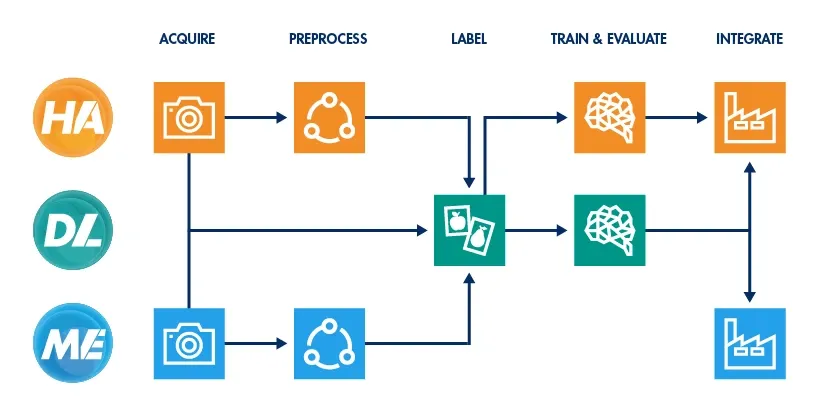
The Deep Learning Tool seamlessly integrates into the MVTec product portfolio with HALCON and MERLIC and serves as the core of your Deep Learning application.
Acquire your images and preprocess them with HALCON or MERLIC if necessary. After labeling, training as well as evaluation in the Deep Learning Tool, deploy your trained network in the respective runtime environment.